The Rolex Report 2026: The same leader, a different market
A Chrono24 analysis of completed transactions from 2018 to Q2 2026 shows Rolex’s pandemic premium has fully unwound. The brand stays in front, but its lead has narrowed across every segment and younger buyers are spreading their money more widely.

Johannes FörsterChrono24
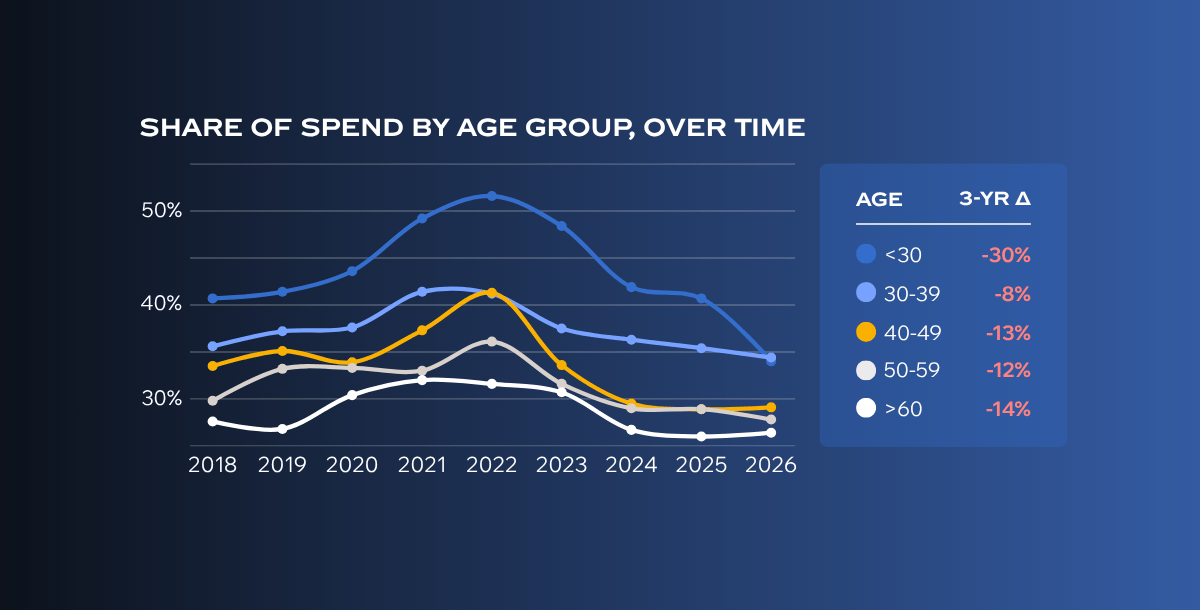
- Under-30 buyers allocate the highest share of their watch spending to Rolex, about 34%. They have also pulled back the most: from roughly half the 2022 peak, a drop of around 30% in three years and the steepest of any age group.
- Rolex has given back share in every price segment since 2023, by 3 to 8 percentage points, as Cartier, Patek Philippe, Audemars Piguet and Vacheron Constantin gain ground.
- Demand is rotating from sports icons to the classic Datejust, now the single largest revenue-contributing collection at about 28%.
- Rolex accounts for 35% of watch transaction volume among North American buyers, its highest regional share, up from about 27% in 2018, while Asian demand has fallen from the low 30s to around 20%.
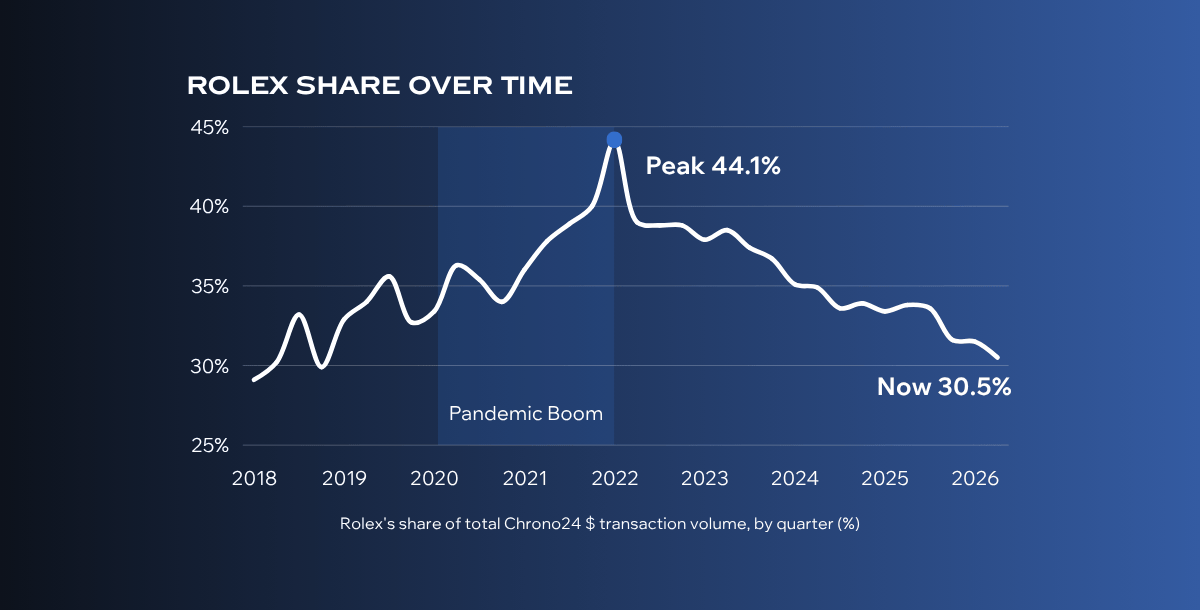
Karlsruhe, August 5, 2026 – Rolex’s pandemic premium has fully unwound. Its marketplace share is back near the pre-2019 level after a 44% peak in early 2022, and prices are climbing again: the Rolex price index sits about 55% above 2019 and rose around 7% over the past year. The sharpest movement now comes from Rolex's youngest buyers. These are among the results of a new analysis of Chrono24’s own marketplace data, covering 2018 to the second quarter of 2026. Rolex remains the largest brand on the Chrono24 marketplace at around 31% of dollar sales volume, ahead of Omega (about 11%) and Patek Philippe (about 6%). What has changed sits underneath that number.
After several years defined by pandemic-era price spikes and scarcity, the market has settled into a calmer phase. That makes this a useful moment to look at how buyers are behaving now that the boom is over, and the clearest answers sit in who is buying and what they choose.
Younger buyers are pulling back the hardest
Buyers under 30 still direct a larger share of their money to Rolex than any older group, about 34% against 27% for the over-60s. They are also retreating fastest. At the 2022 peak, the under-30s put roughly half of their watch spending into Rolex; that has since fallen by about 30% over three years, the steepest decline of any age group. Every age band has eased since the boom. The youngest buyers have moved furthest, toward dressier models and a wider set of challenger brands.
Rivals have recovered across every segment
Rolex still leads every price band above $5,000, and its grip is tightest in the $10,000 to $20,000 tier, where it holds about 61% of sales volume. Above $20,000 it holds close to 39%. That lead has thinned across the board since 2023, by 3 to 8 percentage points depending on the segment. The steepest slip came in its own stronghold: the $10,000 to $20,000 tier, where Rolex commanded more than 70% at the 2022 peak and now sits near 61%. Cartier gained the most in the $5,000 to $10,000 band, while Patek Philippe and Vacheron Constantin picked up ground above $20,000, where Audemars Piguet is also strong. Still, Rolex remains the reference point others are measured against.
Demand is rotating from the sports icons to the classic Datejust
For years the Submariner, GMT-Master II and Daytona defined what people wanted from Rolex. They still sell in volume and together make up close to 38% of revenue. The GMT-Master II is the recent standout, helped by scarcity: after Rolex discontinued the steel “Pepsi” at Watches and Wonders 2026, that reference traded about 24% higher than a year earlier, near $25,000, one of the biggest year-on-year gains among the best-sellers.
The deeper shift is toward dressier timepieces. With younger buyers driving demand away from speculative sports models and into versatile classic-dress styles, the Datejust has become Rolex’s single largest earner at around 28% of revenue. It is also where most collectors begin: the Datejust and Oyster Perpetual are the common entry points, and buyers tend to move on to the Daytona and vintage GMT-Master as they gain experience.
Women commit more to Rolex, and choose different models
Women direct roughly 38% of their watch spending to Rolex, compared with 30% for men. Both shares have normalized since the 2022 peak, with women down about 23% over three years and men about 17%. Their model mix differs, women concentrate on the Datejust and Oyster Perpetual, which come in the smaller case sizes many buyers prefer, while the Daytona, Submariner and GMT-Master II stay strongly favored by men.
Demand is shifting toward North America
The regional map is being redrawn too. North America is now Rolex's strongest region: Rolex accounts for 35% of watch transaction volume among North American buyers, up from about 27% in 2018. Its share of spending among American buyers has risen steadily over the past eight years. Europe holds nearly 29%. Asia has moved the other way, from the low 30s to around 20%.
A market that has grown up
What emerges is a market that has widened around its leader. Three years after the peak, its buyers have moved on from chasing a few hyped references; they now spread their money with intent across a wider field. Rolex has not retreated; the field around it has caught up.
“The pandemic premium is unwound. The clearest signal is generational: younger buyers drove the boom, and they are the ones now moving to other brands and to classic watches like the Datejust. Rolex still sets the tone, but buyers spread their money across more brands than they did three years ago”, says Balazs Ferenczi, Head of Brand Engagement at Chrono24.
Disclaimer
This report is an independent analysis by Chrono24 and is not affiliated with, endorsed by, or sponsored by Rolex SA.
The Rolex Report (USD)
PDF·4 MB